
DocuMeow
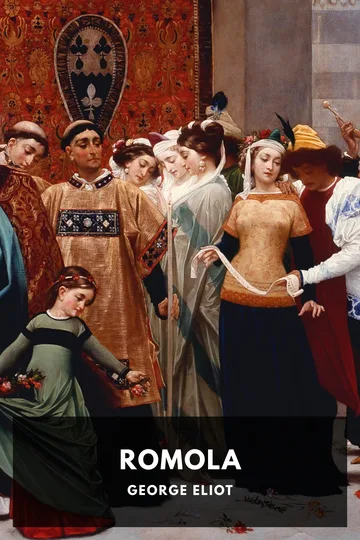
Romola cover Romola

Romola

George Eliot

CC0-1.0 EnglishClassics231,754 words24h 55m listenUnabridged epic

<p>In the late 15th century, a shipwrecked Greek named Tito Melema arrives in a Florence unsettled by the death of Lorenzo de’ Medici. He swiftly wins friends and favor with his quick wits, lightly worn learning, and good looks. He comes to the attention of the blind old scholar, Bardo de’ Bardi, and becomes his assistant. This throws Melema together with Bardo’s beautiful young daughter, Romola. Almost inevitably, the two seemingly sympathetic young people fall in love.</p> <p>This is a time when religion and politics are barely distinguishable in Florentine life: while the fiery preaching of Savonarola deepens rifts, a young <a href="https://standardebooks.org/ebooks/niccolo-machiavelli">Machiavelli</a> is active in civic affairs. This combustible backdrop is dangerous for Melema, for he has a hidden past, as well as a treacherous present; and it transpires that Romola’s family has been riven by religious differences.</p> <p><a href="https://standardebooks.org/ebooks/george-eliot">George Eliot</a> was inspired to write <i>Romola</i> during an extended visit to Florence with her “husband,” George Lewes, in 1860. Eliot immersed herself in the city as she began to imagine a differen


Historical fictionPsychological fictionDomestic fictionMarried women--FictionSavonarola, Girolamo, 1452-1498--FictionWomen--Italy--Florence--FictionGreeks--Italy--Florence--FictionSelf-sacrifice--Fiction

Chapter 1

The Loggia de’ Cerchi stood in the heart of old Florence, within a labyrinth of narrow streets behind the Badia, now rarely threaded by the stranger, unless in a dubious search for a certain severely simple doorplace, bearing this inscription:

To the ear of Dante, the same streets rang with the shout and clash of fierce battle between rival families; but in the fifteenth century, they were only noisy with the unhistorical quarrels and broad jests of woolcarders in the cloth-producing quarters of San Martino and Garbo.

Under this loggia, in the early morning of the 9th of April 1492 , two men had their eyes fixed on each other: one was stooping slightly, and looking downward with the scrutiny of curiosity; the other, lying on the pavement, was looking upward with the startled gaze of a suddenly-awakened dreamer.

The standing figure was the first to speak. He was a grey-haired, broad-shouldered man, of the type which, in Tuscan phrase, is moulded with the fist and polished with the pickaxe; but the self-important gravity which had written itself out in the deep lines about his brow and mouth seemed intended to correct any contemptuous inferences from the hasty workmanship which Nature had bestowed on his exterior. He had deposited a large well-filled bag, made of skins, on the pavement, and before him hung a pedlar’s basket, garnished partly with small woman’s-ware, such as thread and pins, and partly with fragments of glass, which had probably been taken in exchange for those commodities.

Edition & License

License
CC0-1.0
Source
Standard Ebooks
First published
1880
Author death year
1880
Catalog ID
se:george-eliot_romola

More in English

Browse all →

