DocuMeow
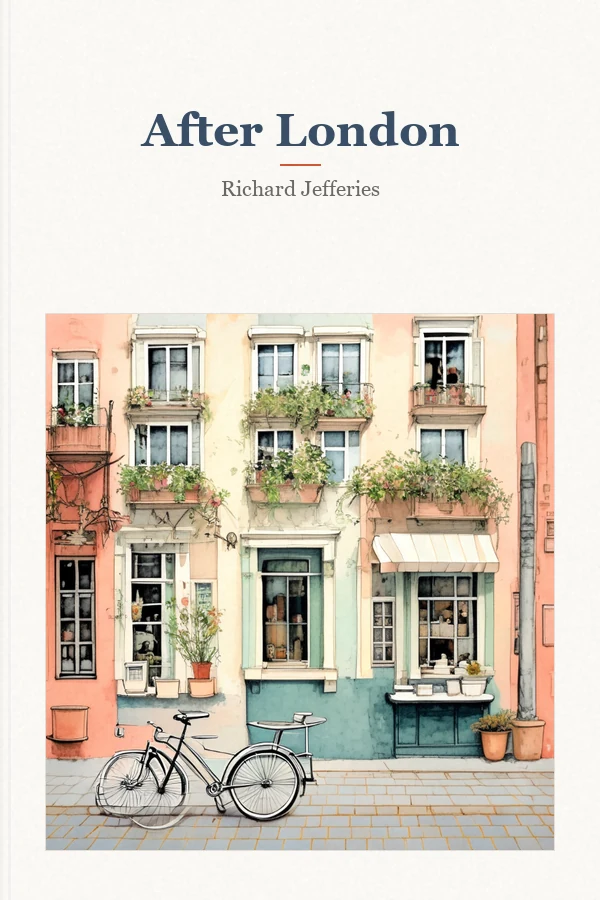
After London cover After London

After London

Richard Jefferies

CC0-1.0 EnglishScience85,465 words9h 11m listenLong

<p><i>After London</i> presents a version of England many generations after an apocalyptic event has drastically depopulated the country, leaving nature to take back the land and human survivors to scrape what they can from their surroundings. Petty kings and corrupt republics rule from the region around the lake that has formed in the middle of the country. Wild men hide in the woods. Society has regressed to a way of life similar to the medieval age.</p> <p>The novel is told in two parts. The first details what’s known of the fall of civilization, while the second part follows the son of a baron as he sets off to explore beyond the kingdom he was born into. Nature, civilization, violence, poverty, exploitation, and exploration are major themes.</p> <p><a href="https://standardebooks.org/ebooks/richard-jefferies">Richard Jefferies</a> wrote the novel toward the end of his life. It combines the nature writing he is traditionally known for, with a fantastical science fiction setting, making it an early example of post-apocalyptic fiction. The surreal exploration of the former site of London bears a striking resemblance to the aftermath of a nuclear explosion, decades before the atom
Science fictionEngland--FictionDystopias--FictionApocalyptic fictionRegression (Civilization)--Fiction

Chapter 1

The old men say their fathers told them that soon after the fields were left to themselves a change began to be visible. It became green everywhere in the first spring, after London ended, so that all the country looked alike.

The meadows were green, and so was the rising wheat which had been sown, but which neither had nor would receive any further care. Such arable fields as had not been sown, but where the last stubble had been ploughed up, were overrun with couch-grass, and where the short stubble had not been ploughed, the weeds hid it. So that there was no place which was not more or less green; the footpaths were the greenest of all, for such is the nature of grass where it has once been trodden on, and by-and-by, as the summer came on, the former roads were thinly covered with the grass that had spread out from the margin.

In the autumn, as the meadows were not mown, the grass withered as it stood, falling this way and that, as the wind had blown it; the seeds dropped, and the bennets became a greyish-white, or, where the docks and sorrel were thick, a brownish-red. The wheat, after it had ripened, there being no one to reap it, also remained standing, and was eaten by clouds of sparrows, rooks, and pigeons, which flocked to it and were undisturbed, feasting at their pleasure. As the winter came on, the crops were beaten down by the storms, soaked with rain, and trodden upon by herds of animals.

Edition & License

License
CC0-1.0
Source
Standard Ebooks
First published
1887
Author death year
1887
Catalog ID
se:richard-jefferies_after-london

More in English

Browse all →