DocuMeow
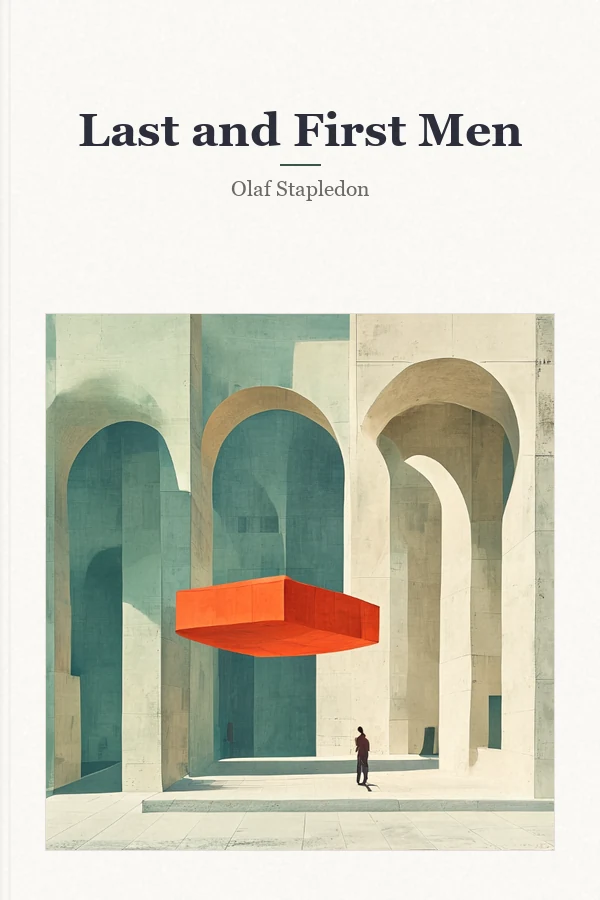
Last and First Men cover Last and First Men

Last and First Men

Olaf Stapledon

CC0-1.0 EnglishScience117,639 words12h 39m listenLong

<p><i>Last and First Men</i> is an extended think piece about the possible future history of humankind, extending from the 1930s into the extreme far future, hundreds of millions of years from now. It’s supposedly narrated by one of the “Last Men,” and dictated to a modern-day “First Man” by a kind of time-travel telepathy. As time moves further and further into the future, <a href="https://standardebooks.org/ebooks/olaf-stapledon">Stapledon</a> switches to overviews of vast stretches of time rather than detailing the events in the lives of individual people. As the march of time progresses over an immense period, many successive and wildly different versions of the human form evolve—or are created.</p> <p>This is Stapledon’s first work of fiction, and is considered a classic of the science fiction genre, influencing writers like <a href="https://standardebooks.org/ebooks/c-s-lewis">C. S. Lewis</a>, Brian Aldiss, James Blish, Arthur C. Clarke and <a href="https://standardebooks.org/ebooks/h-p-lovecraft">H. P. Lovecraft</a>. A multimedia adaptation was created in 2017 by Icelandic composer Jóhann Jóhannsson and subsequently turned into a film in 2018.</p>

Science FictionHuman beings in literature

Chapter 1

Observe now your own epoch of history as it appears to the Last Men.

Long before the human spirit awoke to clear cognizance of the world and itself, it sometimes stirred in its sleep, opened bewildered eyes, and slept again. One of these moments of precocious experience embraces the whole struggle of the First Men from savagery towards civilization. Within that moment, you stand almost in the very instant when the species attains its zenith. Scarcely at all beyond your own day is this early culture to be seen progressing, and already in your time the mentality of the race shows signs of decline.

The first, and some would say the greatest, achievement of your own “Western” culture was the conceiving of two ideals of conduct, both essential to the spirit’s well-being. Socrates, delighting in the truth for its own sake and not merely for practical ends, glorified unbiased thinking, honesty of mind and speech. Jesus, delighting in the actual human persons around him, and in that flavour of divinity which, for him, pervaded the world, stood for unselfish love of neighbours and of God. Socrates woke to the ideal of dispassionate intelligence, Jesus to the ideal of passionate yet self-oblivious worship. Socrates urged intellectual integrity, Jesus integrity of will. Each, of course, though starting with a different emphasis, involved the other.

Edition & License

License
CC0-1.0
Source
Standard Ebooks
First published
1930
Author death year
1950
Catalog ID
se:olaf-stapledon_last-and-first-men

More in English

Browse all →